Partial Dentures in Phoenix & North Scottsdale, AZ
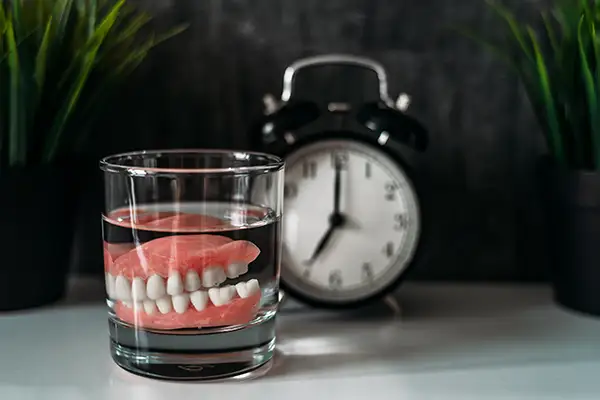 Partial dentures in Phoenix and North Scottsdale, AZ at Jerome Riddle DDS replace several missing teeth on one arch with a custom, removable appliance that holds onto the healthy teeth you still have. Clasps or precision attachments keep it in place, and you take it out to clean it.
A partial makes sense when you’ve lost more teeth than a bridge can handle comfortably, but you still have natural teeth worth keeping. It’s one of the denture options we offer, and it’s often the most practical way to fill gaps in more than one spot at once.
This page focuses on what living with a partial is actually like: how it’s planned around your remaining teeth, what the first few weeks feel like, and how to keep both the partial and the teeth that hold it healthy.
On This Page
How a Partial Denture Works
A removable partial denture is a set of replacement teeth attached to a gum-colored base. According to MouthHealthy, the ADA’s patient site, it may also have a metal framework and clasps that connect to your natural teeth. The teeth that hold it are sometimes called anchor teeth, and the whole design depends on them.
Because it snaps onto teeth you already have, a partial doesn’t need to be cemented in place. You remove it to brush it, and you brush your own teeth separately. That’s the main difference from a fixed dental bridge, which stays in and is cleaned in place.
Clasps or Precision Attachments
Many partials hold on with small clasps that hug the anchor teeth. A precision attachment is a hidden connector instead. MouthHealthy notes that precision attachments are generally more esthetic than clasps, and that a dental crown on a natural tooth is sometimes needed to improve the fit, and is usually required when attachments are used. We offer both designs and will tell you which one your teeth can support.
Partial, Bridge, or Full Denture?
A bridge usually fits a gap of one or a few teeth with solid teeth on each side. A partial is the better fit when gaps are spread around the arch or when a bridge isn’t right for your bite or your remaining teeth. If the teeth that are left can’t be saved, a full denture replaces the whole arch instead. Our overview of tooth loss treatment compares the main options side by side.
Is a Partial Right for You?
You may be a good candidate if most of these describe you:
| • |
Several missing teeth on one arch – especially gaps in more than one spot
|
| • |
Healthy teeth left to hold it – anchor teeth need to be strong and stable enough to carry a clasp or attachment
|
| • |
Gums under control – the teeth carrying a partial need healthy gum support around them
|
| • |
A preference for removable – you want to take the teeth out to clean them, or a long bridge isn’t a good match for the teeth on either side of the gap |
If your exam shows gum disease, we’ll talk about deep cleaning before building an appliance that relies on those teeth. Not sure where you fall? That’s what the first visit is for. We’ll look at each remaining tooth, not just the gaps, and give you a straight answer about which option fits.
Meet Your Dentists
Dr. Jerome Riddle earned his bachelor’s degree at Northern Arizona University and his dental degree at the University of Southern California, then finished a general practice residency at the UCLA and VA hospitals. He has cared for patients in Scottsdale for over two decades. He diagnoses carefully and matches options to each patient’s health history, real needs, and finances, which is exactly where a partial denture conversation begins.
Dr. Eric Johnston completed a biology degree in Chattanooga and graduated from Loma Linda University School of Dentistry in 2017. Blending art, science, and hands-on technique is what he enjoys most about dentistry. A partial puts all three to work: a framework that grips the anchor teeth precisely and replacement teeth that look like they belong next to your own.
How We Make Your Partial
A partial takes several visits because it has to fit two things at once: your gums and the shape of your remaining teeth.
Step 1: Exam and Planning
We start with a comprehensive dental exam, digital X-rays, and intraoral camera photos that put your teeth on a screen in front of you. We check every anchor candidate for decay, cracks, and gum support, because a partial is only as reliable as the teeth holding it.
Step 2: Treatment Before the Partial
Sometimes a tooth needs a filling or crown first, or a failing tooth needs a tooth extraction. When teeth come out, you can either let the area heal before we take final records or choose an immediate denture, which can be a complete or partial denture placed the same day.
Step 3: Impressions and Lab Work
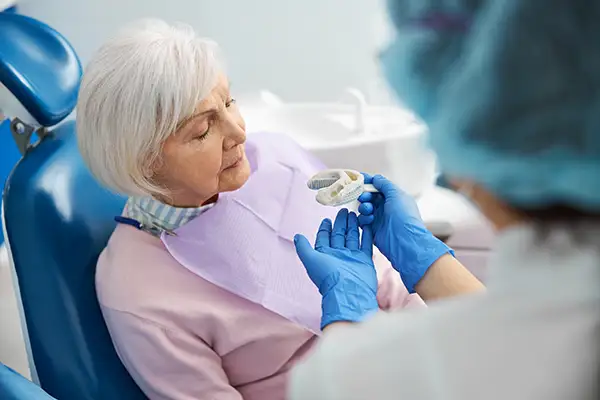 We take impressions and record how your teeth meet, then pick the shade and shape of the replacement teeth with you. A dental lab builds the partial from those records, matching the framework to your anchor teeth.
Step 4: Fitting Day
We seat the partial, check where it presses on your gums, and adjust it before you leave. We’ll show you how to put it in and take it out by hand. MouthHealthy advises never forcing a partial into position by biting down on it.
Step 5: Follow-Up Adjustments
The ADA notes that follow-up visits are generally needed after a denture is placed so the fit can be checked and adjusted. Sore spots are common early on and usually mean one area needs a small trim.
Living With a Partial Denture
The ADA says new dentures may feel awkward for a few weeks, and saliva flow can increase for a while. Speaking and chewing take some practice. Softer foods cut into small pieces make the first days easier.
Daily care has two parts: the partial and your own teeth. MouthHealthy recommends brushing the partial every day to remove food and plaque, using a cleaner your dentist suggests rather than toothpaste, which can be too harsh. A partial can lose its shape if it dries out, so keep it moist when it’s out of your mouth, and most people are told to take it out before bed.
Pay extra attention to the anchor teeth. The ADA notes that dentures collect plaque, stains, and tartar the same way natural teeth do, and the spot under a clasp is easy to miss. A clean partial also helps with breath, a topic our page on bad breath treatment covers, since the underside of a partial can hold bacteria.
Relines, Adjustments and Replacement
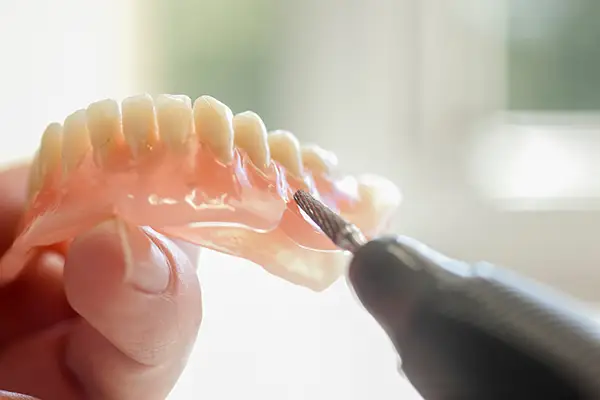 Your mouth keeps changing after teeth are lost, so a partial that fits well today won’t fit exactly the same years from now. The ADA says a denture that feels loose or causes discomfort may need to be relined or replaced, and that a poorly fitting denture can contribute to mouth sores and, with long-term use, bone loss.
The ADA also suggests having a partial evaluated for replacement if it’s been more than five years since it was made, or if the teeth supporting it have changed. We check the fit, the clasps, and the anchor teeth at your regular visits, and we handle adjustments and relines when they’re needed. If a partial cracks or a clasp loosens, call us rather than trying a home repair kit.
Benefits and Trade-Offs
A partial does a lot for the effort involved:
| • |
Fills several gaps at once – one appliance can replace teeth on both sides of an arch
|
| • |
Keeps teeth from drifting – filling the spaces helps stop neighboring teeth from shifting into them
|
| • |
Easier chewing and clearer speech – MouthHealthy notes a partial can help improve speech and make eating more pleasant
|
| • |
Removable for cleaning – you can reach every surface of your own teeth |
The trade-offs are real too. Clasps can sometimes show when you smile, the partial needs daily cleaning outside your mouth, and the fit changes over time, so plan on periodic adjustments. We’ll walk through those points before you decide.
Why Choose Our Office
Most of the sequence happens under one roof: the exam, the extractions or crowns your anchor teeth need, the records, the fitting, and the adjustments after. You won’t bounce between offices for routine steps, and if a tooth looks complicated to remove, we’ll talk about a referral before setting a date.
As a family practice, we check your anchor teeth and gums at the same checkups where we look at the rest of your mouth, so small changes don’t slip by. For older patients, our page on dental care for seniors explains how we adapt visits.
Scheduling is simple. We’re open Monday through Thursday, with 7 a.m. starts on Wednesdays and Thursdays for adjustment visits before work, and our E. Chauncey Lane office sits at the Phoenix and North Scottsdale border.
Cost and Insurance
The cost of a partial denture depends on how many teeth it replaces, clasps versus precision attachments, whether anchor teeth need crowns, and whether any extractions or gum treatment come first. An immediate partial also adds follow-up visits during healing.
We accept Aetna, Cigna, Delta Dental, and MetLife dental insurance, and once your plan is set, our front office gives you a detailed list of fees and an estimate of your out-of-pocket costs. We also offer payment plans, including CareCredit, for qualified patients. Our financial and insurance page has the details, or call 480-991-4410 for your estimate.
Schedule a Consultation
Ready to fill those gaps? Call 480-991-4410 or request an appointment online.
Our office is at 7010 E. Chauncey Ln. Suite #140, Phoenix, AZ 85054-3111. Questions before you book? Reach our office any day we’re open.
Frequently Asked Questions
Should I sleep with my partial denture in?
Usually not. MouthHealthy says dentists generally recommend taking a partial out before bed, which gives your gums a rest. Keep it in water or a soaking solution overnight so it doesn’t dry out and change shape, and we’ll give you specific instructions at your fitting.
Can I clean my partial with regular toothpaste?
No. MouthHealthy warns that toothpaste can be too harsh for dentures and recommends a denture cleaner instead. Brush the partial daily with a soft brush, and brush your own teeth separately with regular fluoride toothpaste.
Will people be able to see my partial?
Sometimes a clasp shows, depending on where it sits. Precision attachments hide the connection and are generally more esthetic, though they usually require crowns on the anchor teeth. We’ll talk through where clasps would sit before the lab builds anything, and we can match the replacement teeth to your natural shade.
Will a partial damage the teeth that hold it?
It shouldn’t, as long as you keep those teeth clean and keep up with checkups. Plaque collects on a partial and around clasps, so the anchor teeth need careful daily brushing and flossing. Our oral hygiene tips apply here, and we check those teeth for decay and gum changes at every visit.
How long does a partial denture last?
There’s no set lifespan, but the ADA suggests having a partial evaluated for replacement once it’s more than five years old or if the teeth supporting it change. When the fit loosens, a reline may be enough. We check its condition at your regular visits so you’re not caught off guard.
What should I do if my partial feels loose or rubs a sore spot?
Call us for an adjustment rather than wearing through it. The ADA notes that a poorly fitting denture can contribute to mouth sores and, over time, bone loss. A sore spot usually traces back to one area pressing too hard, which is often a simple fix.
Can I get a partial the same day my teeth are pulled?
Yes, in many cases. An immediate denture can be a complete or partial denture, built from records taken before the extraction and placed right after. It needs more adjustments while your gums heal, which our immediate dentures page explains step by step.
Does dental insurance cover partial dentures?
Most plans pay toward dentures, but waiting periods, yearly limits and maximums differ a lot. When crowns or extractions come first, one year’s maximum may not cover every phase, so we can help you plan the timing. Our front office checks your benefits and gives you an estimate before treatment starts.
|